
Synopsis
An omnibus boarding house story spanning three eras: Showa, Heisei, and Reiwa.
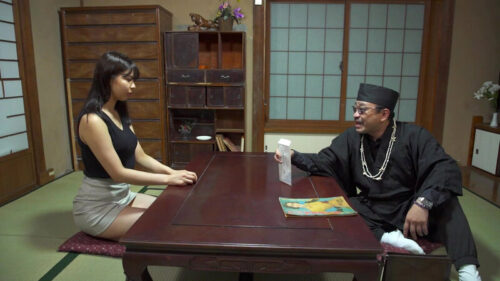
【Showa Era】Ozaki, a tenth-year college entrance exam repeater, is introduced to a boarding house run by Yuko (Kira Kaoru), a widow burdened with massive debt…
【Heisei Era】Ozaki preparing for his entrance exam suffers a traffic accident that costs him a year, only to discover the culprit is Miyuki (Aihara Reno), who runs the boarding house…
【Reiwa Era】Disappointed to learn the widow’s boarding house no longer exists, Ozaki discovers a share house managed by Arisa (Hasegawa Chisa)…




Editorial Review
The widow’s boarding house remains a durable framework for adult video narratives, and this fourth installment leans heavily into temporal scope as its distinguishing feature. Rather than deepening a single scenario, “Counting Fortunes” cycles through three Japanese eras—Showa, Heisei, and Reiwa—each introducing a different female lead (Kira Kaoru, Aihara Reno, Hasegawa Chisa) while maintaining Ozaki as the recurring male anchor. This omnibus structure is increasingly common in DLsite video work, but the specific execution here uses temporal distance as thematic resonance: each era ostensibly reshuffles the boarding house premise while circling back to similar power dynamics and transactional intimacy.
What sets this apart from standard omnibus cycling is the narrative throughline tying Ozaki’s stalled ambitions (perpetual exam repeater, accident victim, nostalgic wanderer) to institutional collapse—the widow’s boarding house itself disappears by the Reiwa segment, forcing a lateral shift to the share house economy. This reflects actual Japanese social transitions and gives the repetition a structural logic beyond mere scenario recycling. The casting choices matter: Aihara Reno and Kira Kaoru are veteran performers in this particular niche, and their presence signals familiarity-with-depth rather than generic substitution.
The HD production tag indicates solid technical quality, though boarding house video work rarely distinguishes itself on cinematography alone. This is fundamentally for viewers who’ve already invested in the series’ continuity or who specifically seek the widow/mature female dynamic across multiple iterations. The appeal lies in accumulated familiarity rather than innovation—each era functions as a variation, not a reinvention.
For viewers chasing temporal scope, cast consistency, and the specific appeal of repeating scenarios across decades of Japanese social change, this delivers exactly what its structure promises. For those seeking novelty within the boarding house format, the omnibus approach may feel more incremental than expansive.
This Week’s Top Rankings:
Related Tags:
HD | Widow | adult video | VR
📖 How to buy on DLsite — step-by-step guide
💳 Payment methods for overseas buyers (Visa/MC declined?)
Interested? Get the free trial here ↓