
Synopsis
Genius, talent, and ordinariness. Weak gods and strong gods.
A story beyond happiness itself.
This is the second act of the sakura’s tale.
A genius chosen by gods, a talent forsaken by gods, an ordinary person who defies gods.
What is the Charis that dwells in beauty? Why is its fruit given only to the chosen?
“Where do we come from? What are we? Where are we going?”
A world where the light of causal exchange is bound.
Can artists answer these questions through beauty?
A story centered on Naoya Kusanagi after Sakura no Shi.
The final scene where Naoya and Ai descended from that slope, looking out over the town of Yumihara.
There were many untold stories before reaching that moment.
Two geniuses.
The true story of Kei Natsume and Naoya Kusanagi.
Why do they continue to captivate people as artists, even after death or putting down their brushes?
Mio Misakura, a painter who is the very embodiment of beauty.
Why does she seek to move forward beyond where they stopped?
What of Rina Hikawa? Yumi Kawanano? Makoto Toriya? And Ai Natsume?
The desires of all people intersect.
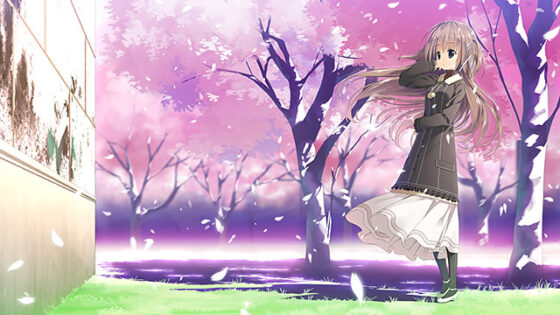




Editorial Review
Sakura no Koku positions itself as a philosophical sequel to an established visual novel universe, trading the coming-of-age arc of its predecessor for something far more introspective: an examination of artistic legacy, divine favor, and the cost of talent across generations. This is character-driven narrative work that uses the school setting less as backdrop and more as psychological terrain where genius and ordinariness collide.
What distinguishes this from the glut of romance-focused visual novels is its thematic ambition. The synopsis telegraphs a work less interested in romantic payoff than in metaphysical questions—”Where do we come from? What are we? Where are we going?”—filtered through the lens of artistic creation and beauty. The structure deliberately revisits prior events (“untold stories before reaching that moment”), suggesting a narrative strategy built on recontextualization rather than forward momentum. The protagonist arrangement is equally distinctive: instead of centering a single romance, Sakura no Koku distributes narrative weight across multiple perspectives (Naoya, Kei, Mio, Rina), each positioned as an answer to why certain artists continue to resonate even in absence or silence. This multi-focal approach is relatively uncommon in the visual novel space, where linear perspective tends to dominate.
The tags emphasize “Excellent Scenario” and “Engaging Story” alongside the beautiful artwork, which suggests the developers understood this as a writing-first project. The emotional and philosophical depth implied by the synopsis demands strong execution; whether that execution arrives will determine whether readers find themselves contemplating art’s purpose or simply appreciating competent melodrama.
This works best for readers already invested in the Sakura series and those seeking visual novels that treat romance as context rather than climax—players comfortable with ambiguity and philosophical uncertainty as central rather than incidental. A substantial work for those who believe visual novels can interrogate meaning.
This Week’s Top Rankings:
Related Tags:
visual novel | romance | school setting | character driven | emotional
📖 How to buy on DLsite — step-by-step guide
💳 Payment methods for overseas buyers (Visa/MC declined?)
Interested? Get the free trial here ↓
![Autumn Hot Spring Inn Secrets [Android]](https://henhenta.com/wp-content/uploads/2026/10/RJ01739664-300x225.jpg)
![[Smartphone Version] Elf’s Hole [Hurricane.com]](https://henhenta.com/wp-content/uploads/2026/10/RJ01690744-300x225.jpg)
![Patron Police [Smartphone Version]](https://henhenta.com/wp-content/uploads/2026/10/RJ01693588-300x225.jpg)
![Squeeze★Extraction Nightmare! [Mushaborareru Kibou]](https://henhenta.com/wp-content/uploads/2026/10/RJ01722380-300x225.jpg)
![Tower of Aldia [Smartphone Version]](https://henhenta.com/wp-content/uploads/2026/10/RJ01263861-300x225.jpg)
![Kingdom Knight Dad [Smartphone Version] | DLsite](https://henhenta.com/wp-content/uploads/2026/10/RJ01493524-300x225.jpg)