
Synopsis
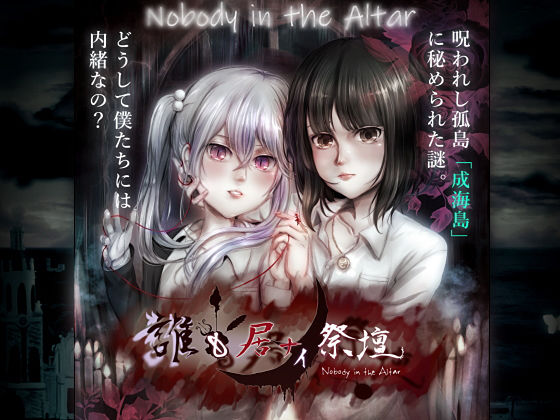
“Restore the dead to life.” A true descent into infernal sorcery—a horror novel set on a cursed isolated island, “Naruumi Island.”
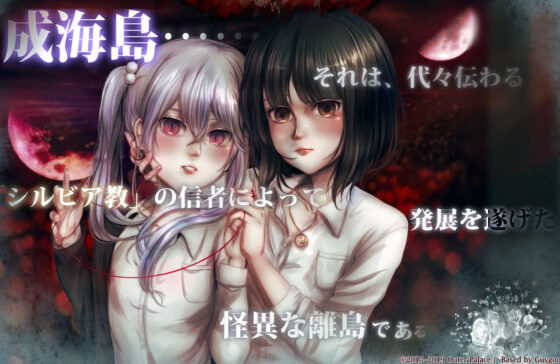
Naruumi Island is a small island located far from the Japanese archipelago.
Set in the 1980s. After a certain incident, Reigetsu Toriumi and her sister-in-law Ichiko Toriumi move to Naruumi Island in their aunt’s care for the new year, relocating from the mainland. The two, who had been living in the city, gradually become accustomed to the island’s unique customs and regional characteristics under their aunt Himiko Toriumi’s care, slowly blending in with the islanders.
Then one day, driven by curiosity, Reigetsu and Ichiko venture into a forbidden zone known as District C, an uninhabited area of the island. What they witness there is an inexplicable malevolent spirit. In confronting it, they discover a connection to “Sylvia Faith”—a traditional religion tied to Naruumi Island itself.
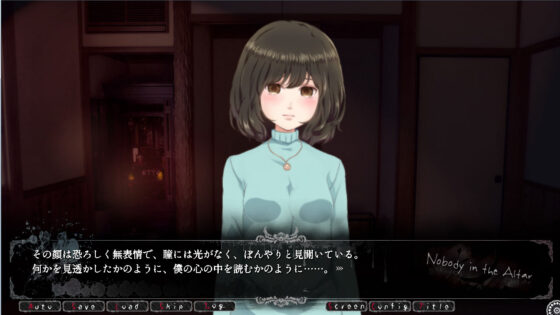
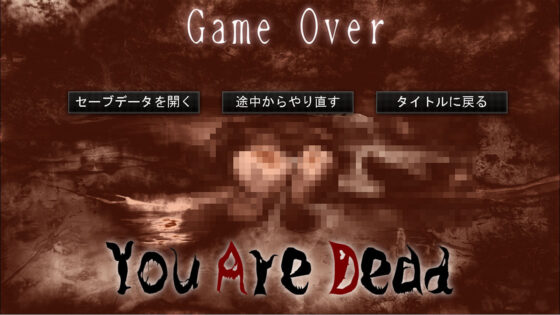
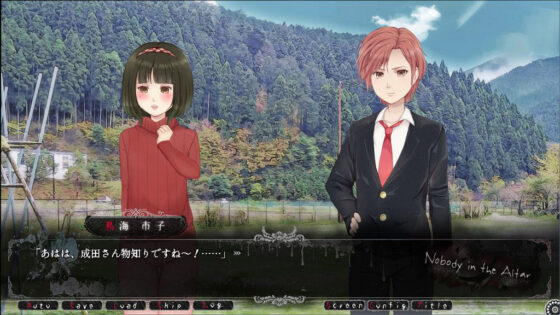
The game functions as a visual novel through the middle section, then switches to an adventure-style format in the latter half where players flee through a pitch-black frontier forest, using choices to escape from creatures.
Editorial Review
No One at the Altar positions itself as a psychological horror visual novel in a genre increasingly crowded with supernatural mysteries set in isolated communities. What distinguishes this work is its deliberate shift in mechanical structure—the hybrid approach that transitions from traditional visual novel pacing into what appears to be a more interactive adventure framework. This format variance mirrors the narrative’s own descent into chaos, making form serve content rather than treating them as separate concerns.
The 1980s setting on Naruumi Island creates effective temporal distance from modern narrative conventions, grounding the horror in period-specific isolation and folklore authenticity. The “Sylvia Faith” religious system anchors the supernatural elements to established worldbuilding rather than random supernatural encounters, suggesting the developers invested in coherent mythology. The dual-protagonist structure with Reigetsu and Ichiko offers multiple perspectives on the unfolding madness, potentially allowing the narrative to explore psychological horror through contrasting responses to the same events. The explicit prohibition against the forbidden District C immediately creates narrative tension—audiences instinctively recognize this as the threshold where the story’s stakes escalate.
Tags emphasizing darkness and psychological elements over action indicate this prioritizes existential dread and narrative revelation over pacing-driven thrills. The “creatures” tag combined with the synopsis’s “inexplicable malevolent spirit” suggests body horror or entity design meant to unsettle rather than provide conventional antagonistic threats.
This appeals specifically to readers seeking literary-leaning horror that respects folkloric grounding and narrative architecture, particularly those comfortable with slower builds and psychological tension over plot momentum. The mechanical pivot midway through suggests an experimental approach—risky, but potentially rewarding for audiences fatigued by conventional visual novel linearity.
A solid entry into the thoughtful horror space, elevated by its willingness to structurally mirror the protagonist’s psychological deterioration.
Get “No One at the Altar -Hysteria-” on DLsite
This Week’s Top Rankings:
Related Tags:
Adventure | visual novel | all ages | Horror | psychological
📖 How to buy on DLsite — step-by-step guide
💳 Payment methods for overseas buyers (Visa/MC declined?)
Interested? Get the free trial here ↓
![Autumn Hot Spring Inn Secrets [Android]](https://henhenta.com/wp-content/uploads/2026/10/RJ01739664-300x225.jpg)
![[Smartphone Version] Elf’s Hole [Hurricane.com]](https://henhenta.com/wp-content/uploads/2026/10/RJ01690744-300x225.jpg)
![Patron Police [Smartphone Version]](https://henhenta.com/wp-content/uploads/2026/10/RJ01693588-300x225.jpg)
![Squeeze★Extraction Nightmare! [Mushaborareru Kibou]](https://henhenta.com/wp-content/uploads/2026/10/RJ01722380-300x225.jpg)
![Tower of Aldia [Smartphone Version]](https://henhenta.com/wp-content/uploads/2026/10/RJ01263861-300x225.jpg)
![Kingdom Knight Dad [Smartphone Version] | DLsite](https://henhenta.com/wp-content/uploads/2026/10/RJ01493524-300x225.jpg)