
Synopsis
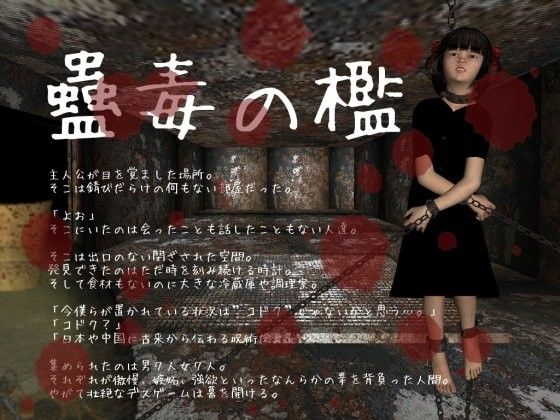
The protagonist awakens in a place they don’t recognize.
It’s a rust-covered, empty room.
“Hey there.”
The people present are strangers they’ve never met or spoken to before.
It’s a sealed space with no exit.
The only thing they find is a clock that keeps ticking away.
Yet there’s a large refrigerator and kitchen despite having no food.
“I think the situation we’re in right now is ‘Kodoku’…”
“Kodoku?”
“It’s an ancient curse ritual passed down through Japan and China.”
Gathered together are 7 men and 7 women.
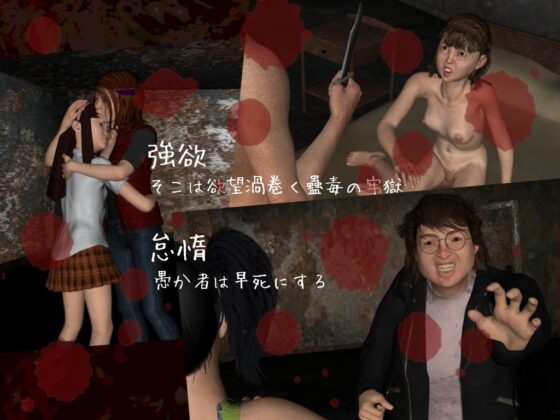
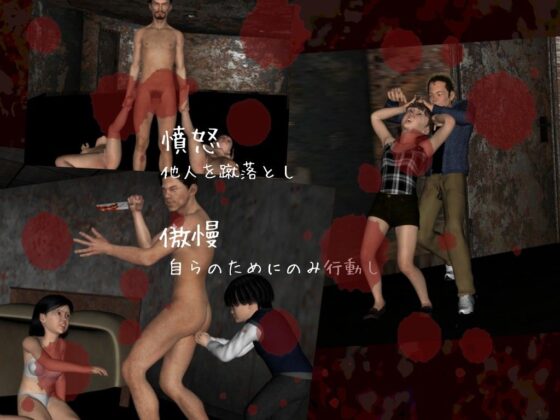
Each carries their own sins—arrogance, jealousy, greed, and more.
Soon, a brutal death game begins.


Editorial Review
The Poison Vessel’s Cage anchors itself in the death game subgenre—a saturated space dominated by battle royales and elimination mechanics—but distinguishes itself through psychological horror rooted in Japanese folklore and interpersonal decay rather than combat spectacle. The invocation of “Kodoku,” a ritual curse framework, immediately signals thematic ambition beyond simple survival mechanics. This is a work interested in how isolation, sin, and forced intimacy corrode character psychology before bodies hit the ground.
The tag combination here is genuinely uncommon: NTR alongside yuri, death game, and psychological thriller creates narrative tension that most adult games avoid. Rather than pivoting toward voyeuristic titillation as window dressing, the work appears to weaponize voyeurism and relationship betrayal as psychological torture—making carnal elements inseparable from the characters’ deterioration. The presence of violence and voyeurism tags suggests this isn’t sanitized thriller territory; expect genuine depravity lurking beneath the supernatural framing. The fourteen-character ensemble cast, each supposedly burdened by distinct moral failings, hints at a branching narrative structure where character perspective and alliance-building directly impact who survives and how they fall.
Production quality seems oriented toward visual storytelling; the rust-covered setting, ticking clock, and incongruous kitchen detail create strong atmospheric imagery. The Kodoku framework—positioning the game as curse rather than manufactured spectacle—allows for psychological horror grounded in cultural dread rather than sci-fi logistics.
This appeals most to readers comfortable with morally messy character work, psychological unraveling as primary tension, and adult content that reflects degradation rather than titillation. The work demands patience for atmosphere over action.
A genuinely unsettling psychological death game that weaponizes relationship dynamics and cultural horror tropes into something distinctly uncomfortable—exactly the kind of dissonant, character-driven nightmare the death game subgenre desperately needs.
Get “The Poison Vessel’s Cage” on DLsite
This Week’s Top Rankings:
📖 How to buy on DLsite — step-by-step guide
💳 Payment methods for overseas buyers (Visa/MC declined?)
Interested? Get the free trial here ↓


![Thanatos -Smartphone Version- [triangle!]](https://henhenta.com/wp-content/uploads/2026/10/RJ01690733-300x225.jpg)
![【Smartphone】Troimerai to Hand-Folded Flowers [+Crab]](https://henhenta.com/wp-content/uploads/2026/10/RJ01690731-300x225.jpg)
![[Smartphone Version] Biotechnurse [Tenkatsu]](https://henhenta.com/wp-content/uploads/2026/10/RJ01610337-300x225.jpg)