Synopsis
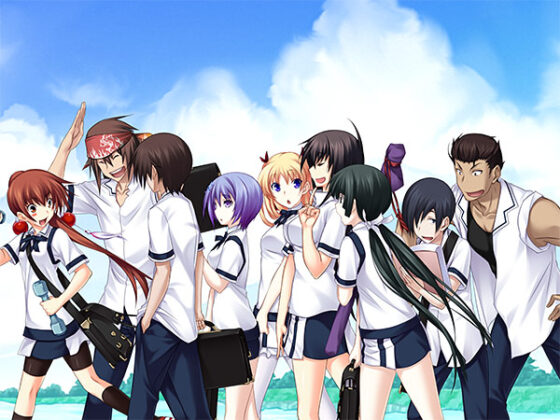
Naoe Yamato, a second-year student at Kawakami Academy, enjoys life with his close group of friends—four boys and three girls. When two new members join their circle, their daily routine becomes even more eventful. Though Yamato has no particular girlfriend, he’s content with how things are.
But fate is about to change everything. The powerful Kuuki conglomerate accelerates their “Bushido Plan”—an initiative to create clones of historical figures to address modern talent shortages. By having these celebrated women study alongside ordinary students, they hope to inspire greater competitive spirit and ability development.
As a result, numerous individuals connected to the plan, including the legendary Minamoto no Yoshitsune and Kuuki Ayashiro, transfer to Kawakami Academy. The campus becomes a media sensation, and Yamato’s surroundings grow even more lively. Independently, an older student named Matsunaga Tsubame also gets involved with the group.
What these girls have in common: they all practice martial arts and carry the blood of samurai lineages. The boys must hold their own against these spirited samurai maidens. In June 2009, a new story begins.




Editorial Review
Majikoi S operates in the robust subgenre of romantic comedies anchored by ensemble casts and school-life settings, a space where character chemistry matters far more than narrative coherence. This sequel positions itself as an escalation—the addition of cloned historical figures (particularly older women like Matsunaga Tsubame) to an already substantial friend group transforms what could have been straightforward slice-of-life romance into something deliberately overstuffed and deliberately comedic about that overstuffness.
What distinguishes this work is its explicit embrace of the ensemble dynamic as a structural principle rather than a limitation. The tags reveal the formula: battle elements and historical figures inject absurdist energy into what might otherwise be routine school-life scenarios, while the strategic inclusion of older women broadens the romantic appeal beyond the typical teenage-focused visual novel. The comedy appears designed to operate through sheer cast saturation—watching Yamato navigate romantic possibility among an expanding circle of distinct personalities, including literal clones of legendary warriors, prioritizes absurdist humor and interpersonal dynamics over tight plotting.
The “Bushido Plan” premise, while potentially shallow, functions as permission for the narrative to introduce whatever character archetypes serve the comedic and romantic goals. This isn’t subtle storytelling; it’s architectural—build the cast, establish chemistry, let personalities collide.
This targets players who derive maximum enjoyment from large ensemble casts where no single route dominates, who appreciate romantic comedy that leans into situational humor rather than dramatic tension, and who embrace the ridiculous premise as part of the appeal rather than despite it. The combination of school-life comfort with historical-figure novelty, filtered through a romantic-comedy lens that embraces its own chaos, remains a potent draw.
A reliable ensemble romcom that understands its own formula well enough to make overcrowding feel intentional rather than messy.
This Week’s Top Rankings:
Related Tags:
romance | comedy | battle | Romantic Comedy | older women
📖 How to buy on DLsite — step-by-step guide
💳 Payment methods for overseas buyers (Visa/MC declined?)
Interested? Get the free trial here ↓

![Thanatos -Smartphone Version- [triangle!]](https://henhenta.com/wp-content/uploads/2026/10/RJ01690733-300x225.jpg)
![【Smartphone】Troimerai to Hand-Folded Flowers [+Crab]](https://henhenta.com/wp-content/uploads/2026/10/RJ01690731-300x225.jpg)
![[Smartphone Version] Biotechnurse [Tenkatsu]](https://henhenta.com/wp-content/uploads/2026/10/RJ01610337-300x225.jpg)