
Synopsis
――It all began as a god’s pastime――
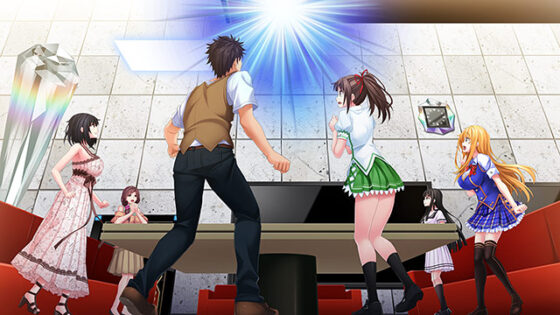
Protagonist Kiryama Kazuma and five women suddenly find themselves trapped in an unfamiliar room. Among them are Kazuma’s cousin Kiryama Kokoro, Kokoro’s classmate Mizushima Moe, high-born lady Enshouji Kotoko, medical student Ishidou Mizuki, and married woman Makishima Yuriko.
Above their confused heads, a sphere of light materializes. It sings a mocking song, as if savoring every word: “Who will die, who will live? Those filthy humans who survive…♪ Let’s all deceive one another♪ God’s game is about to begin♪”
The sphere introduces itself: “Hello everyone. I am God.” Refusal is not permitted. The so-called god unilaterally demands their participation. The six naturally refuse—but the moment they do, unspeakable terror descends. Arms are severed. Bellies are torn open. As panic sets in, the god declares the game paused, and their wounds instantly heal.
They understand now: refuse, and you die.
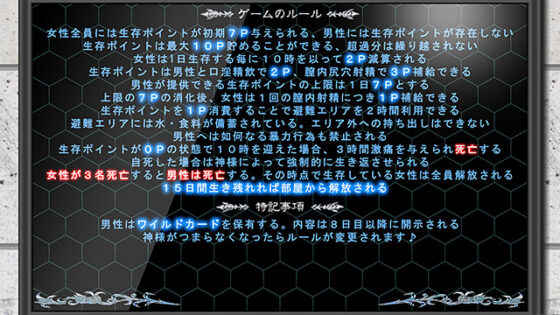
God’s Game is a death game that forces a cruel harem upon its participants. The six are given the rules—rules so bizarre and unbelievable, they defy comprehension.


Editorial Review
Dark death game narratives have flooded the adult visual novel market since the mid-2010s, but God’s Game distinguishes itself by anchoring its cruelty in genuine relationship fracture rather than isolated shock. The forced proximity of six captives—including familial and social bonds that predate the game—creates psychological weight that elevates this beyond standard “strangers in a room” setups. The core tension isn’t just survival; it’s the systematic destruction of trust between people who actually know each other.
What separates this from derivative entries is the deliberate narrative design around the harem framework. Rather than collecting romance options, the game weaponizes intimacy itself. The presence of Kazuma’s cousin Kokoro, alongside unrelated women, establishes immediate moral and emotional complications that pure strangers cannot. The god’s explicit instruction to “deceive one another” isn’t window dressing—it’s the mechanism by which the death game corrodes the social bonds that might otherwise allow cooperation. This transforms the harem tag into something genuinely unsettling instead of incidental.
The sphere itself as an antagonist is refreshingly abstract. By refusing to embody a human antagonist, the work sidesteps the common pitfall of psychological thrillers that collapse under the weight of explaining their villain’s motivation. Instead, the game operates on pure, incomprehensible cruelty—a more honest reflection of meaningless suffering than narrative rationalization would permit.
The violence tags signal genuine graphic content rather than tasteful fade-to-black, and the psychological thriller positioning suggests this prioritizes mental deterioration over titillation, which narrows but deepens its appeal significantly.
This appeals most to readers who want their harem premises subverted, who can tolerate sustained psychological horror, and who appreciate death games that actually interrogate why cooperation fails.
A genuinely disturbing take on forced proximity narratives that respects its own cruelty.
This Week’s Top Rankings:
Related Tags:
visual novel | Harem | violence | dark | Suspense
📖 How to buy on DLsite — step-by-step guide
💳 Payment methods for overseas buyers (Visa/MC declined?)
Interested? Get the free trial here ↓
![Autumn Hot Spring Inn Secrets [Android]](https://henhenta.com/wp-content/uploads/2026/10/RJ01739664-300x225.jpg)
![[Smartphone Version] Elf’s Hole [Hurricane.com]](https://henhenta.com/wp-content/uploads/2026/10/RJ01690744-300x225.jpg)
![Patron Police [Smartphone Version]](https://henhenta.com/wp-content/uploads/2026/10/RJ01693588-300x225.jpg)
![Squeeze★Extraction Nightmare! [Mushaborareru Kibou]](https://henhenta.com/wp-content/uploads/2026/10/RJ01722380-300x225.jpg)
![Tower of Aldia [Smartphone Version]](https://henhenta.com/wp-content/uploads/2026/10/RJ01263861-300x225.jpg)
![Kingdom Knight Dad [Smartphone Version] | DLsite](https://henhenta.com/wp-content/uploads/2026/10/RJ01493524-300x225.jpg)