

Synopsis
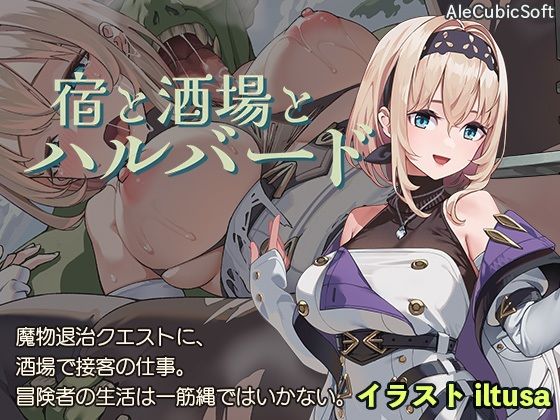
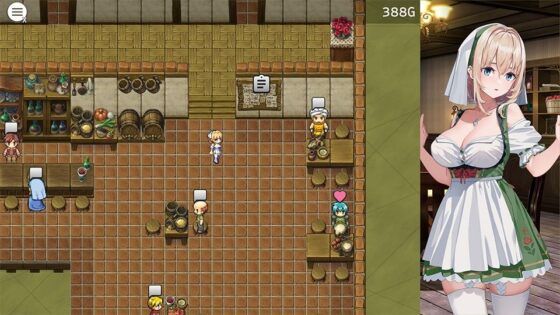
Monster extermination quests and tavern work—an adventurer’s life is never simple.
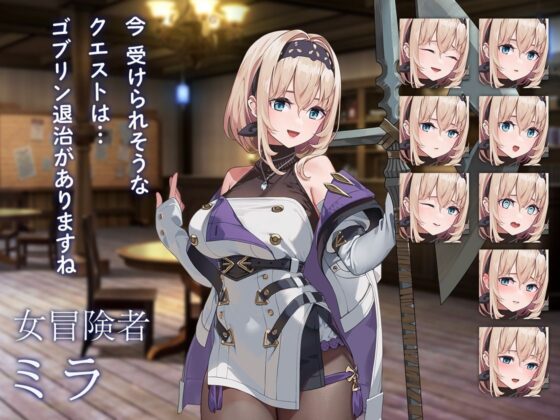
Mira, an adventurer, travels in search of her missing lover. He was once her party mate, a man with whom she shared dreams of the future.
Seeking clues to his whereabouts, Mira arrives at a guild in a certain town.
But what fate awaits her there…?
Will Mira safely reunite with the one she loves?
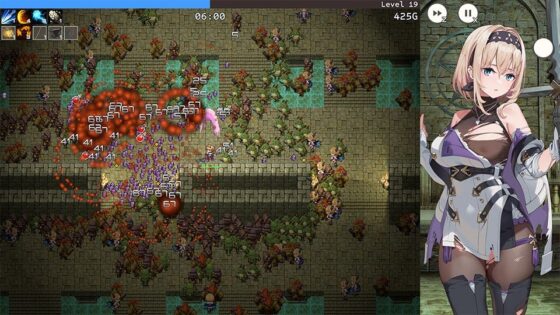
A survivor action game where you battle waves of encroaching monsters. Select randomly acquired skills with each level up to strengthen your character. Failing quests triggers H scenes. Repeated failures lead to a bad ending.
Editorial Review
A roguelike action-adventure hybrid that uses mechanical failure as its primary narrative engine, *Inn, Tavern, and Halberd* occupies the intersection of skill-based combat and story branching—a space increasingly populated in the doujin scene, though rarely with such deliberate thematic cohesion. The core design loop demands competence: clear quests to advance Mira’s search for her missing lover, or face sexually compromising consequences that reshape the narrative itself. This isn’t simply adult content bolted onto gameplay; failure mechanics are the story’s skeleton.
The distinctive appeal lies in how the work weaponizes player agency against emotional investment. A female protagonist hunting for a beloved companion presents familiar romantic scaffolding, yet the NTR and pregnancy tags signal the work’s willingness to corrupt that yearning into degradation. The roguelike skill acquisition system—choosing randomly offered upgrades with each level—creates genuine uncertainty about whether you’ll have the tools to succeed, making quest failure feel less like missed player skill and more like circumstance conspiring against Mira’s reunion. The tavern work framing suggests downtime narrative sequences that likely contextualize her desperation, adding tragic weight to mechanical vulnerability.
Mechanically competent players will experience a more traditional romance-driven narrative; those struggling with combat difficulty will witness Mira’s circumstances deteriorate in ways tied directly to their inadequacy. This dual-outcome structure rewards mastery while making struggle meaningfully punitive rather than merely inconvenient.
Best suited for players who appreciate how game mechanics and narrative can reinforce each other thematically, and who specifically seek scenarios where protagonist degradation stems from player failure rather than predetermined story beats. Those seeking straightforward wish-fulfillment fantasy should look elsewhere.
A mechanically grounded action game that transforms roguelike difficulty into narrative consequence—compelling for those willing to accept that mechanical failure has emotional cost.
Interested? Get the free trial here ↓
This Week’s Top Rankings: