
Synopsis
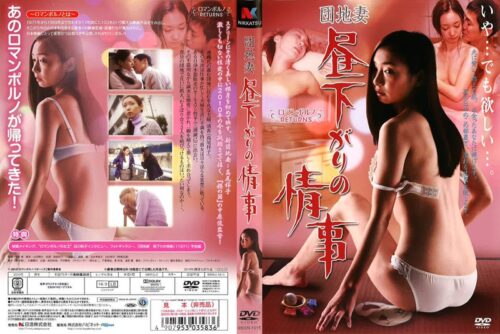
Kiyoka (Shoji Takao) is a full-time housewife living in an apartment complex. Her husband Tomoji is always busy with work, leaving them with little meaningful communication. Living in the suffocating environment of the apartment complex—surrounded by the lonely deaths of elderly residents, meddlesome neighbors, and poorly-behaved children—the frustrated Kiyoka one day meets Teppei (Makoto Miura), a suspicious water purifier salesman. Suddenly, they cross the line and desperately desire each other with intense passion. What could possibly bind these two hungry souls together in broad daylight within the apartment complex…?


Editorial Review
Apartment Wife: Afternoon Affair positions itself squarely within the Nikkatsu Roman Porno tradition—that distinctly Japanese exploitation subgenre that balanced softcore sexuality with genuine dramatic architecture and social commentary. This work leans heavily into the marital ennui that became the movement’s bread and butter: the bored housewife trope, but grounded in specific environmental detail rather than pure fantasy scaffolding.
What distinguishes this entry is its attention to claustrophobic mise-en-scène. The apartment complex functions as more than mere backdrop; the synopsis deliberately foregrounds it as a character itself—death, surveillance, and social friction creating the psychological pressure that drives Kiyoka toward transgression. The catalyst is tellingly mundane: a water purifier salesman, which transforms an ordinary domestic intrusion into something that feels inevitable rather than contrived. The narrative framework emphasizes temporal specificity (broad daylight encounters) and psychological desperation rather than opportunistic seduction, which keeps the work anchored in character motivation rather than pure titillation mechanics.
The casting—Shoji Takao as Kiyoka, Makoto Miura as Teppei—suggests a period production treating these roles as actors rather than bodies, which historically correlates with stronger dramatic execution in Roman Porno output. The series tag indicates developed narrative space across multiple installments, allowing for complications and character evolution that single-entry works rarely sustain.
This appeals most directly to viewers seeking authentic 1970s-80s Japanese exploitation cinema: those interested in how sexuality functioned as both escape valve and social critique, where female desire gets articulated as response to systemic alienation rather than innate promiscuity. The production values and dramatic philosophy distinguish it from contemporary softcore work.
A legitimately structured entry in a canonical subgenre—effective precisely because it prioritizes emotional texture alongside physical hunger.
This Week’s Top Rankings:
Related Tags:
Married Woman | romance | drama | Housewife | series
📖 How to buy on DLsite — step-by-step guide
💳 Payment methods for overseas buyers (Visa/MC declined?)
Interested? Get the free trial here ↓