
Synopsis
【Story】
The royal capital of Heres is home to eight prestigious noble houses, including House Exkna. Sigrid, daughter of the house’s regent king, hides her identity to become a gladiator. Meanwhile, spy Rowen infiltrates Heres disguised as a slave trader, accompanied by Mikado Koharu, a ninja of the demon clan. In the arena of Heres, the story of these three begins.
【Gameplay】
◆Controls
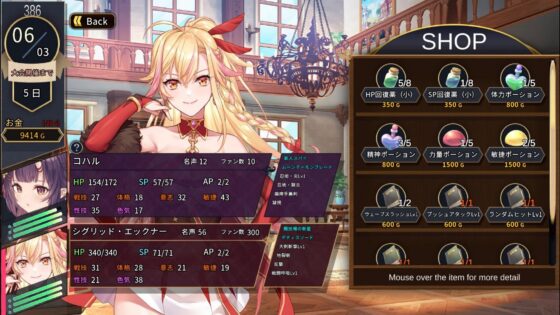
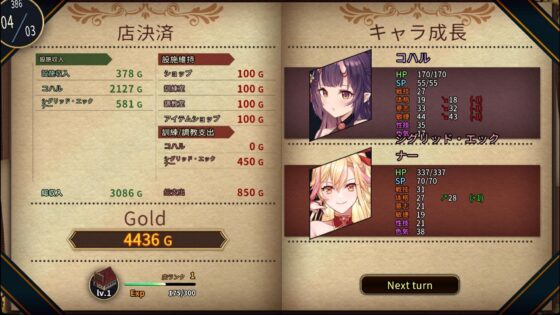
Slaves can earn money by accepting requests. Players develop slaves through “facility improvements” and “training,” enabling them to take on higher-level assignments and earn greater rewards.
◆Growth
Enhance slave abilities and master combat techniques through “training” and “conditioning.” “Facility upgrades” increase training efficiency and unlock more powerful items in shops, including powerful skills that significantly boost combat strength.
◆Arena
Face challenging battles in the arena with substantial rewards for victory. Select slaves with different combat styles and combine various skills strategically. Exploit enemy weaknesses and gain the upper hand!
【Game Features】
◆Approximately 170,000 words of story text
◆30 base CGs with over 200 variations
◆Full Japanese voice acting
◆Free-form slave development with diverse combat styles
◆Seductive training visuals
◆Multiple scenarios and varied endings based on arena performance



Editorial Review
Horace’s Arena II plants itself firmly in the gladiator-simulation genre that’s seen steady traction since the original’s success, but this sequel adds meaningful strategic depth through its triadic character dynamics and slave-management framework. The premise—a noblewoman in disguise, a spy, and a demon-clan ninja converging in an arena economy—provides genuine narrative tension absent from many combat sims that treat plot as window dressing.
What distinguishes this entry is the integration of simulation mechanics with character-driven storytelling. Rather than isolating combat from progression, the game binds arena victories to facility upgrades and training systems that meaningfully alter tactical options. The emphasis on “combining various skills” and selecting slaves with “different combat styles” suggests the developers understand that strategic depth requires real build variety. The voice acting tag signals production attention beyond the typical doujin baseline, particularly valuable when narrative beats hinge on character interactions across Sigrid’s dual identity and Rowen’s infiltration plot. Multiple endings and character development tags indicate branching consequences tied to how you develop and deploy your roster—a structure that rewards experimentation across playthroughs rather than punishing deviation from an optimal path.
The facility-improvement loop will appeal strongly to players who find resource optimization satisfying. However, the synopsis cuts off mid-sentence on skill mechanics, leaving questions about whether the depth extends beyond incremental stat-chasing. The slave-management framing invites the adult content as a natural extension of the power-dynamic setup rather than tacked-on fanservice, which older arena-sim fans will appreciate.
This is essential for players who want simulation scaffolding that justifies repeated playthroughs through branching outcomes and gear combinations. Casual combat fans may find the meta-layer demanding, but strategists will find solid mechanical bones beneath the arena spectacle.
Get “Horace’s Arena II (Joy Brick) ” on DLsite
This Week’s Top Rankings:
Related Tags:
Fantasy | Simulation | voice acting | adult content | Multiple Endings
📖 How to buy on DLsite — step-by-step guide
💳 Payment methods for overseas buyers (Visa/MC declined?)
Interested? Get the free trial here ↓


![Thanatos -Smartphone Version- [triangle!]](https://henhenta.com/wp-content/uploads/2026/10/RJ01690733-300x225.jpg)
![【Smartphone】Troimerai to Hand-Folded Flowers [+Crab]](https://henhenta.com/wp-content/uploads/2026/10/RJ01690731-300x225.jpg)
![[Smartphone Version] Biotechnurse [Tenkatsu]](https://henhenta.com/wp-content/uploads/2026/10/RJ01610337-300x225.jpg)