Synopsis
[Story]
You play as a robot created by a girl named Tsuki. She needs you to eventually reach the Farlands.
Lend her your aid and accomplish her dream together!
[Features]
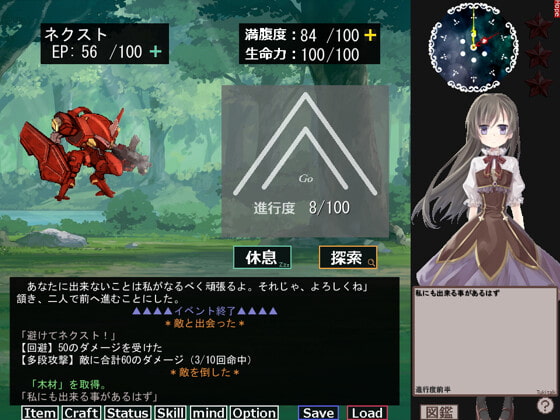
– Keep an eye on your resources while you triumph over powerful enemies and insurmountable obstacles!
– Aside from name entry, the game can be controlled via the mouse.
– With the “Willpower” system, the impossible becomes possible! This system will let you improve your battle skills and sometimes even force your way through certain events! You can even expend all your Willpower to avoid some battles completely!


| Circle | koko-wa-dare-no-sora |
| Tags | Role-playing, Music, Application, Japanese |
| Price | 0JPY |
Editorial Review
Make for the Farlands positions itself as a resource-management-heavy RPG with a companion narrative hook—a framing device increasingly common in indie doujin titles, though rarely executed with mechanical depth. What distinguishes this work is the integration of the Willpower system, a mechanic that blurs the line between combat progression and narrative agency by allowing players to circumvent obstacles entirely rather than simply optimize damage output.
The game’s architecture reveals careful design philosophy. The emphasis on resource scarcity during combat encounters suggests a survival-horror or tactical-puzzle sensibility grafted onto traditional RPG structure, while the Willpower mechanic functions as both a difficulty-adjustment valve and a narrative permission system—certain story gates become passable only through expenditure, creating meaningful trade-offs between combat preparation and plot advancement. This dual functionality is rarely seen in the application-based doujin space, where most games treat progression systems and narrative branching as separate concerns.
The mouse-controlled interface and minimal text input (name entry only) indicate deliberate accessibility design, lowering friction for players who want mechanical engagement without interface friction. That the developers prioritized streamlined controls suggests confidence in their core loop and enemy design. The Japanese-language tag combined with Western-oriented game nomenclature and English synopsis hints at crossover appeal, a smart positioning in the current doujin market.
The inclusion of a music tag without elaboration leaves expectations deliberately vague, though in RPGs of this scope it typically signals atmospheric accompaniment rather than rhythm-game integration.
This is essential for players who value mechanical agency and resource tension over narrative elaboration. Fans of puzzle-box RPG design and the “Willpower-as-currency” approach to player choice will find substantive depth here.
A mechanics-first RPG that trusts its systems and respects player time—exactly the kind of focused experience the doujin space does best.
Get “Make for the Farlands” on DLsite
This Week’s Top Rankings:
Related Tags:
Japanese | Application | Music | Role-playing | Hentai Game
📖 How to buy on DLsite — step-by-step guide
💳 Payment methods for overseas buyers (Visa/MC declined?)
Interested? Get the free trial here ↓